
Do You Need a Helmet for Sim Racing? The Honest Answer (Plus the Best Options)
TL;DR
You do not need a helmet for sim racing from a safety perspective — there is no physical danger. But a significant number of serious sim racers choose to wear one anyway, and the reasons make more sense than they might initially appear. Immersion, head position consistency, VR headset integration and the simple fact that you are trying to replicate the experience of being in a race car are all genuine motivations. If you are going to wear a helmet, wear a real FIA-certified motorsport helmet. The best options available in the UK are from Bell, Stilo and OMP — all stocked at SimTorque.
Table of Contents
1. Do you actually need a helmet for sim racing?
2. Why serious sim racers wear helmets
3. What makes a sim racing helmet different?
4. Understanding FIA helmet certifications
5. The best helmets for sim racing
6. Bell vs Stilo vs OMP — which should you choose?
7. FAQ
Do You Actually Need a Helmet for Sim Racing?
No. There is no physical danger in sim racing that requires head protection. You are sitting in a cockpit that is not moving at speed, and in the event of a problem the worst that happens is the simulation stops.
But "do you need it" and "should you consider it" are different questions, and the answer to the second one is more interesting.
A meaningful proportion of the sim racing community — particularly those using motion platforms, full-motion rigs, or virtual reality headsets — choose to wear a helmet as part of their setup. The reasons are practical as well as aesthetic.
Why Serious Sim Racers Wear Helmets
Immersion and mental engagement. Sim racing is partly a physical activity and partly a mental one. The more your brain believes it is in a race car, the more effectively you engage with the simulation. Putting on a proper motorsport helmet — the same type worn by real racing drivers — is a surprisingly effective part of that mental preparation. Many sim racers describe a genuine shift in their focus and commitment when they are helmeted.
Head position consistency on motion platforms. On a 3DOF or 6DOF motion platform, your head moves during the simulation. A helmet adds weight that stabilises head movement and can improve the consistency of your reference points — particularly relevant for VR users where head tracking accuracy matters.
VR headset integration. Several helmets — most notably the Stilo ST5 VR — are specifically designed to accommodate VR headsets. The helmet holds the headset in the correct position and distributes its weight more comfortably than wearing the headset directly. For sim racers committed to VR, a helmet designed for it is a practical choice.
Because racing looks and feels better with one. This is a legitimate reason. You are building a racing simulator to feel like a race car driver. Racing car drivers wear helmets. If the aesthetics and immersion of the complete experience matter to you — and if they do not, you would not have invested in your rig — a helmet is a natural part of the picture.
What Makes a Sim Racing Helmet Different?
Nothing, technically. The best helmets for sim racing are exactly the same helmets used in actual circuit racing. There is no specific "sim racing" helmet category.
What you are looking for is a full-face motorsport helmet that is comfortable to wear for extended sessions, appropriately sized, and — for VR users — compatible with your headset. The FIA certification specifications (see below) are the relevant quality standards.
One practical consideration that does differ from real-world use: ventilation matters more in sim racing than in a real car. In a real car, the cockpit airflow provides some ventilation. In a sim rig you are stationary, and a helmet's internal temperature management becomes more relevant over a long session. Higher-specification helmets with better ventilation systems are worth considering for extended sim racing use.
Understanding FIA Helmet Certifications
FIA certification standards tell you what testing regime the helmet has passed. For sim racing buyers, understanding the key standards helps make sense of pricing:
FIA 8858-2010 / 8858-2018 — The standard for open-cockpit racing. Full-face helmets certified to this standard are tested for high-speed impacts and visor penetration relevant to open-wheel racing. This is the higher end of the certification spectrum.
FIA 8859-2015 — Covers rally and circuit racing, with particular attention to fire resistance. Many of the Bell and Stilo helmets in the SimTorque range carry this certification.
Snell SA2020 — A widely used North American standard. Snell-certified helmets are tested to a high impact resistance standard and are accepted at most motorsport venues internationally.
For sim racing purposes, the specific certification is less critical than in real motorsport — you are not racing under any regulatory body's technical rules. The certifications are useful primarily as quality and build standard indicators. An FIA or Snell-certified helmet has been independently verified to meet a defined structural standard.
The Best Helmets for Sim Racing
Bell RS7 Carbon
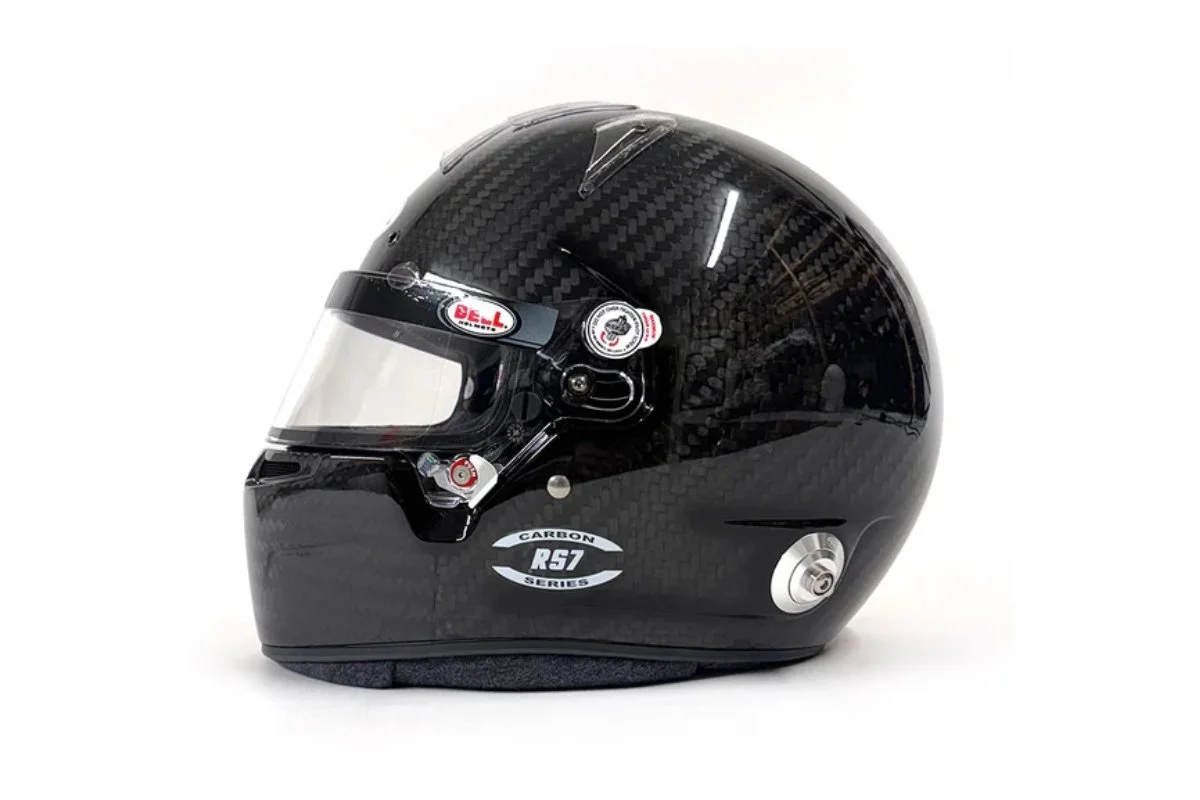
The Bell RS7 Carbon is a full-face circuit racing helmet certified to FIA 8859-2015 and FIA 8860-2018 standards. Bell has been producing motorsport helmets since 1954 and the RS7 Carbon represents their current premium offering for circuit racing — the helmet of choice for professional drivers in touring cars, GT championships and various single-seater formulae.
The RS7 Carbon shell is carbon fibre, keeping weight to a minimum while maintaining the structural integrity required by its dual FIA certifications. The interior ventilation system is designed for circuit racing use and manages temperature well across long sessions. At £1,369 from SimTorque, the RS7 Carbon is a premium purchase — but it is the same helmet that drivers use in professional racing.
View the Bell RS7 Carbon at SimTorque →
[ https://simtorque.co.uk/collections/bell ]
Stilo Range
Stilo is an Italian manufacturer specialising in motorsport safety equipment. Their helmets are found throughout professional and club motorsport and the Stilo ST5 range in particular has become a benchmark for quality and value at the serious end of the market.
The Stilo ST5 VR is specifically designed to accommodate VR headsets — a rare example of a product that bridges genuine motorsport use and sim racing practicality. If VR is central to your sim racing setup, the ST5 VR is the most thoughtfully designed option available.
The broader Stilo range covers multiple certification levels and price points. All Stilo helmets in the SimTorque range are FIA-certified motorsport helmets built to genuine racing standards.
View the Stilo range at SimTorque →
[ https://simtorque.co.uk/collections/stilo ]
OMP Helmets
OMP produces a comprehensive range of motorsport helmets across multiple price points and certification levels. For sim racers looking for a quality FIA-certified helmet without the premium of the Bell RS7 Carbon or top-specification Stilo, OMP's fibreglass-shell offerings represent excellent value — the same manufacturer that produces the OMP racing seats stocked at SimTorque also produces helmets that meet the same rigorous FIA testing standards.
View all helmets at SimTorque →
[ https://simtorque.co.uk/collections/helmets ]
Bell vs Stilo vs OMP — Which Should You Choose?
Choose Bell RS7 Carbon if: you want the top-tier circuit racing helmet used by professionals, weight is a priority (carbon shell), and budget is not the primary constraint.
Choose Stilo if: you use VR and want a helmet designed to accommodate a VR headset (ST5 VR), or you want an Italian-engineered helmet with a reputation for refinement and build quality across a range of price points.
Choose OMP if: you want a properly FIA-certified motorsport helmet at a more accessible price point from a manufacturer with credibility across the full range of sim racing hardware.
All three are genuine motorsport helmet manufacturers. None of them produces "gaming" or "sim racing" specific helmets — they make racing helmets, which happen to be the right choice for serious sim racers.
FAQ
Will wearing a helmet in sim racing actually make a difference?
Most sim racers who try it and then stop report missing it. The immersion contribution is real, particularly on motion platforms. Whether it changes your lap times is debatable; whether it changes your engagement with the simulation is not.
What size helmet should I order?
Measure the circumference of your head at the widest point — typically around 2–3cm above your eyebrows. Compare against the manufacturer's size chart. Helmets should fit snugly without pressure points. Sizing varies between manufacturers, so check each manufacturer's specific guide.
Can I wear a full-face helmet with a VR headset?
Depends on the helmet. Standard full-face helmets have a chin bar that makes fitting most VR headsets difficult. The Stilo ST5 VR is specifically designed to accommodate a VR headset through the visor opening. Some sim racers modify or use open-face helmets for VR — but the ST5 VR is the purpose-designed solution.
Are Bell, Stilo and OMP helmets available for delivery within the UK?
Yes — all helmets from SimTorque include free UK delivery. Delivery timeframes are shown on each product page.
How long does a motorsport helmet last?
FIA certification standards typically expire after ten years. Most manufacturers and regulatory bodies recommend replacing helmets after a major impact regardless of age, and after five years of regular use as a general guideline. For sim racing use without crash risk, helmets last indefinitely in structural terms, but the FIA-certified standard applies if you also use the helmet for track days.