
DOF Reality H3 vs H6 — Which Motion Platform Should You Buy?
TL;DR
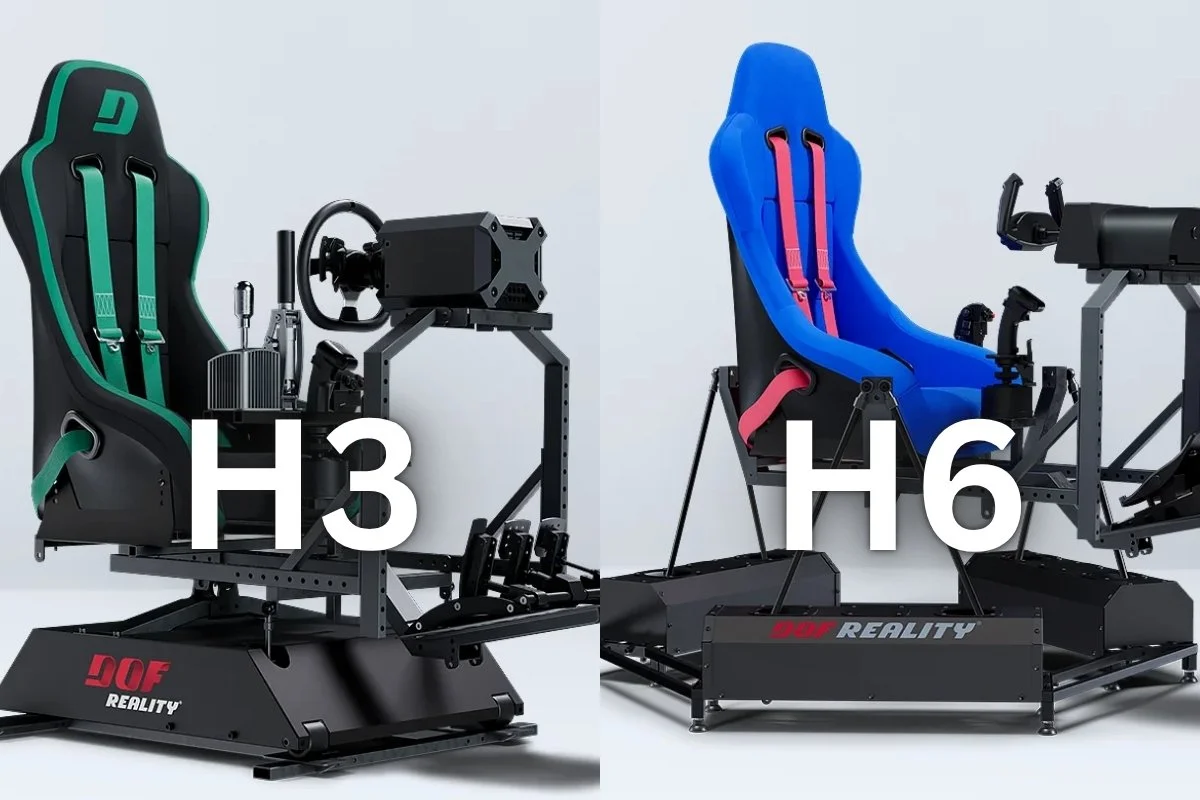
The DOF Reality H3 (from £2,843) offers three axes — pitch, roll and traction loss. The H6 (from £4,200+) adds heave, surge and sway for a full six-axis experience. The H3 is the right choice for the majority of home sim racers. The H6 is for those who want the most immersive experience available and have the space and budget to match. If you are choosing purely on value, the H3 wins clearly.
Table of Contents
1. Quick comparison
2. What does each axis actually feel like?
3. Price difference — is the H6 worth it?
4. Space requirements
5. Tuning complexity
6. Who should buy the H3?
7. Who should buy the H6?
8. Our verdict
9. FAQ
Quick Comparison
DOF Reality H3 | DOF Reality H6
Axes | 3 (Pitch, Roll, Traction Loss) | 6 (Pitch, Roll, Traction Loss, Heave, Surge, Sway)
Pitch angle | ±18° | ±18°
Roll angle | ±18° | ±18°
Heave | No | Yes
UK price | From £2,843 | From £4,200+
Footprint | Medium | Larger
Assembly time | 4–6 hours | 6–9 hours
Tuning complexity | Moderate | High
Best for | Most home sim racers | Maximum immersion, larger spaces
Both are available with free UK delivery from SimTorque.
What Does Each Axis Actually Feel Like?
Understanding the difference between these two platforms starts with understanding what each axis contributes to the driving experience.
The H3's three axes
Pitch is the forward and backward tilt of the platform. Under heavy braking, the platform tilts you forward. Under acceleration, it tilts you back. This is the most immediately intuitive form of motion feedback and the one that most directly mirrors what you feel in a real car.
Roll is the lateral tilt through corners. As lateral load builds in a fast corner, the platform tilts toward the outside of the corner, loading you against the seat bolster. Like pitch, this is immediately readable and physically convincing.
Traction loss — the third axis of the H3 — is where things get genuinely interesting. When the rear steps out, the platform rotates around the yaw axis, giving you a physical signal of oversteer before it fully registers visually. Experienced sim racers consistently report that their car control improves with this axis because the body starts to respond to physical cues the same way it does in a real car.
These three axes together cover the motion feedback that most directly affects how you drive. This is why the H3 is the most popular platform in the DOF Reality range.
What the H6 adds
Heave is vertical movement — up and down. Kerb strikes, elevation changes, track surface bumps and compression at the bottom of a hill all become physical sensations through heave. This is widely considered the most significant addition the H6 makes over the H3. Once experienced, track topography that was previously only visual becomes physically tangible.
Surge is forward and backward linear movement — distinct from pitch in that the whole platform moves rather than tilting. Under hard braking, you feel the platform push you forward. Under acceleration, it pushes you back. Combined with pitch, the sensation of weight transfer becomes more complete.
Sway is lateral linear movement. Through high-speed corners, the platform pushes you toward the outside of the corner simultaneously with rolling. The combination of sway and roll together gives a more complete reading of lateral load than roll alone.
The H6 experience is meaningfully more immersive than the H3. The question is whether that additional immersion is worth the difference in cost, space and tuning complexity.
Price Difference — Is the H6 Worth It?
The H6 typically costs around £1,400–£1,800 more than the H3. That is a significant sum that in a sim racing context could alternatively purchase a mid-range direct drive wheelbase, a set of load cell pedals, or a quality FIA racing seat.
The honest answer is that the H3 delivers the motion feedback that most directly improves your driving — traction loss and corner load. The H6 adds immersion that is noticeable and genuine, but it does not fundamentally change how you drive in the way the traction loss axis does.
If your sim racing budget has a ceiling and you are choosing between the H6 and the H3 plus meaningful hardware upgrades elsewhere, the H3 plus upgrades gives you more total performance improvement than the H6 alone.
If budget is genuinely not a constraint, the H6 is the better experience and worth every penny.
Space Requirements
The H3 has a moderate footprint. Most sim racing rooms and dedicated spaces accommodate it without difficulty, but it is larger than a static rig and requires clear space around it for the range of motion.
The H6 is larger still. The additional actuators increase both the footprint and the clearance space required during operation. Before purchasing an H6, measure your space carefully. The DOF Reality website provides detailed dimensional drawings for both platforms.
If space is constrained, this can be a deciding factor in favour of the H3 even if budget allows the H6.
Tuning Complexity
Both platforms use SimTools for motion control software. The H3's three axes are manageable for a sim racer willing to spend time learning the software — most users have a working, well-tuned profile within a few evenings.
The H6's six axes require more tuning time to balance correctly. Heave in particular interacts with pitch and surge in ways that require careful calibration to avoid conflicting signals or motion sickness. The H6 rewards the tuning effort with a genuinely exceptional result, but the time investment is higher.
If you are new to motion simulation, starting with the H3 and learning the fundamentals of motion tuning on three axes before stepping up to six is a sensible approach.
Who Should Buy the H3?
The H3 is the right choice if:
• Your budget is under £3,500
• You are new to motion simulation and want to learn on a well-regarded, manageable system
• Your sim racing space is standard sized
• You want the motion feedback that most directly affects car control — traction loss and corner load — without the additional tuning complexity of six axes
• You plan to allocate budget to other hardware — seat, wheelbase, pedals — as well as the motion platform
The H3 is the most popular DOF Reality platform and the one most sim racers recommend to others considering motion for the first time. It is an excellent, durable, well-supported product at a price that makes it accessible to committed home sim racers.
View the DOF Reality H3 at SimTorque →
[ https://simtorque.co.uk/products/dof-reality-h3-3dof-motion-simulator-platform ]
Who Should Buy the H6?
The H6 is the right choice if:
• Budget for the platform alone is £4,000+
• You have dedicated sim racing space with room for a larger footprint
• You have experience with motion simulation — either on an H3 or another system — and you understand what you are tuning
• Maximum immersion is your primary goal
• You run titles with detailed track surface data — iRacing, Assetto Corsa, rFactor 2 — where the heave axis generates genuinely informative feedback
The H6 is one of the most immersive home motion simulation experiences available at any price. For the right buyer in the right space, it justifies every pound of its premium over the H3.
View the full DOF Reality range at SimTorque →
[ https://simtorque.co.uk/collections/dof-reality ]
Our Verdict
For the majority of UK sim racers, the H3 is the right choice. It delivers the motion axes that matter most for driving, it is tunable to a high standard without excessive complexity, and it comes in at a price that leaves room in the budget for the rest of a high-quality sim racing setup.
The H6 is exceptional. If the budget and space are there, it is a step up worth taking. But it is a luxury upgrade, not a necessity. The H3 is the sweet spot.
FAQ
Can you upgrade an H3 to an H6 later?
DOF Reality does offer upgrade paths between some models, but it is not a straightforward bolt-on process and it is not the same as purchasing an H6 from new. If you think you will want the H6 experience eventually, it may be more cost-effective to purchase the H6 from the outset rather than planning an upgrade.
Which has better resale value — the H3 or H6?
Both hold value well in the used sim racing market. The H3 is more liquid — more buyers at that price point — while the H6 commands higher prices but has a smaller pool of potential buyers.
Do both platforms work with the same games?
Yes. Both the H3 and H6 use SimTools and are compatible with the same library of sim racing titles. The H6 simply generates richer motion output from the same game data by utilising the additional axes.
Is free UK delivery available for both?
Yes — SimTorque offers free UK delivery on both the DOF Reality H3 and H6.
How loud is the H6 compared to the H3?
The H6 has more actuators and is generally slightly louder during operation than the H3. Isolation pads and proper bolt tightening reduce noise on both platforms, but the H6's additional mechanical components mean it is unlikely to be quieter than an equivalent H3 setup.