
2DOF vs 3DOF Motion Platform — Which Is Actually Worth It?
TL;DR
The difference between 2DOF and 3DOF motion simulation is the traction loss axis — a yaw rotation that physically communicates when the rear of the car is stepping out. For most sim racers, this single axis is the most impactful form of motion feedback available. The price gap between quality 2DOF and 3DOF platforms is typically £200–£600. In almost every case, 3DOF is worth the additional cost.
Table of Contents
1. What does 2DOF actually give you?
2. What does 3DOF add?
3. The traction loss axis — why it matters
4. Price difference — is 3DOF worth it?
5. When 2DOF makes sense
6. When 3DOF makes sense
7. Our recommendation
8. FAQ
What Does 2DOF Actually Give You?
2DOF motion platforms move your rig across two axes — pitch and roll.
Pitch is the forward and backward tilt of the platform. Under braking, the platform tilts you forward — you feel your weight loading into the harness and the front of the seat. Under acceleration, it tilts you back into the seat. This is the most immediately intuitive form of motion feedback and it directly mirrors the feeling of weight transfer in a real car.
Roll is the lateral tilt through corners. As you enter a fast corner, the platform tilts toward the outside, loading you against the outer bolster of the seat. In a hard left-hander, the platform tilts right. The sensation gives a physical reading of lateral load that complements the visual and haptic feedback from your wheel.
Together, pitch and roll give you the two primary axes of feedback for what the whole car is doing — accelerating, braking and cornering. It is a genuinely useful and immersive experience, and for sim racers who have never tried motion, even 2DOF is a substantial upgrade over a static setup.
What Does 3DOF Add?
3DOF adds a third axis — yaw rotation, configured to deliver traction loss feedback.
Traction loss in a 3DOF platform means that when the rear of the car breaks traction — oversteer, a snap slide, kerb-induced rotation — the platform rotates around the vertical axis. Your body physically moves in the direction of the rear end's movement. If the rear steps left, the platform rotates to send your body left relative to the direction of travel.
This is physically distinct from what pitch and roll communicate. Pitch and roll tell you about the overall forces on the car. Traction loss tells you specifically what the rear axle is doing — and it tells you physically, before you have fully processed it visually.
The Traction Loss Axis — Why It Matters
The traction loss axis is the most discussed upgrade in motion simulation for a reason. It changes how you drive.
In a real car, you develop feel for the rear over thousands of hours of driving. Your body learns to sense small movements at the rear of the car and your hands and feet respond before your conscious mind fully processes what is happening. This is what experienced drivers call "feel" — and it is learned through physical experience, not visual information.
In a static sim or a 2DOF motion rig, traction loss is communicated visually and through the steering wheel's force feedback. You see the car rotating and you feel the wheel loading and unloading. For drivers who have years of real-world experience, this is sufficient to maintain physical intuition. For drivers without that background, developing feel for the rear on a static setup is harder.
The 3DOF traction loss axis gives your body physical information about the rear of the car. Over time, your body learns to use that information the same way it would in a real car. Many sim racers report meaningful improvements in their ability to manage oversteer after time on a 3DOF platform — not because the simulation is better, but because the feedback channel their body naturally uses has been added.
This is why experienced sim racers so consistently describe the traction loss axis as the most impactful upgrade they have made.
Price Difference — Is 3DOF Worth It?
The price gap between comparable 2DOF and 3DOF platforms varies. Looking at the platforms available from SimTorque:
The eMotion Simulators e2 (2DOF) is priced from £2,994. The DOF Reality H3 (3DOF) is priced from £2,843. In this specific case, the 3DOF platform is actually slightly cheaper than the 2DOF, which makes the choice straightforward for anyone primarily guided by value.
More generally, in the motion platform market, 3DOF systems cost around £200–£600 more than equivalent 2DOF systems from the same manufacturer. This premium is consistently worth paying for sim racers who care about car control.
The traction loss axis is not a marginal improvement. It is a qualitatively different experience that sim racers who have used 3DOF describe as difficult to go back from.
When 2DOF Makes Sense
2DOF is the right choice in a small number of specific circumstances:
You primarily run titles where rear traction management is less central. Some sim titles — touring cars, oval racing, certain GT classes — are less demanding in terms of rear traction feel than open-wheel or high-powered GT racing. If your sim racing library is focused on these categories, the traction loss axis generates less useful feedback.
You have tried 3DOF and genuinely prefer the 2DOF motion character. Some sim racers find that the smoother, more refined feel of a premium 2DOF platform — like the eMotion e2 — is more enjoyable than the three-axis feedback of a 3DOF system that requires more tuning to settle correctly. This is a legitimate preference.
Build quality is the priority and budget is fixed. If the choice is between a premium 2DOF platform and a budget 3DOF platform, the quality difference may justify the 2DOF choice.
When 3DOF Makes Sense
3DOF is the right choice for the majority of sim racers. Specifically:
• You run sim racing titles with high-fidelity physics — Assetto Corsa, ACC, iRacing, rFactor 2, Dirt Rally
• Improving your feel for the rear of the car and your ability to manage oversteer is a goal
• You are making this purchase once and want the most useful form of motion feedback
• The price difference between 2DOF and 3DOF options is within your budget tolerance
For most sim racers, this describes their situation accurately. 3DOF is the default recommendation.
Our Recommendation
For the vast majority of UK sim racers choosing their first or upgraded full-rig motion platform, 3DOF is the right choice. The traction loss axis is the most impactful single addition available in motion simulation and it is worth prioritising over other considerations in most cases.
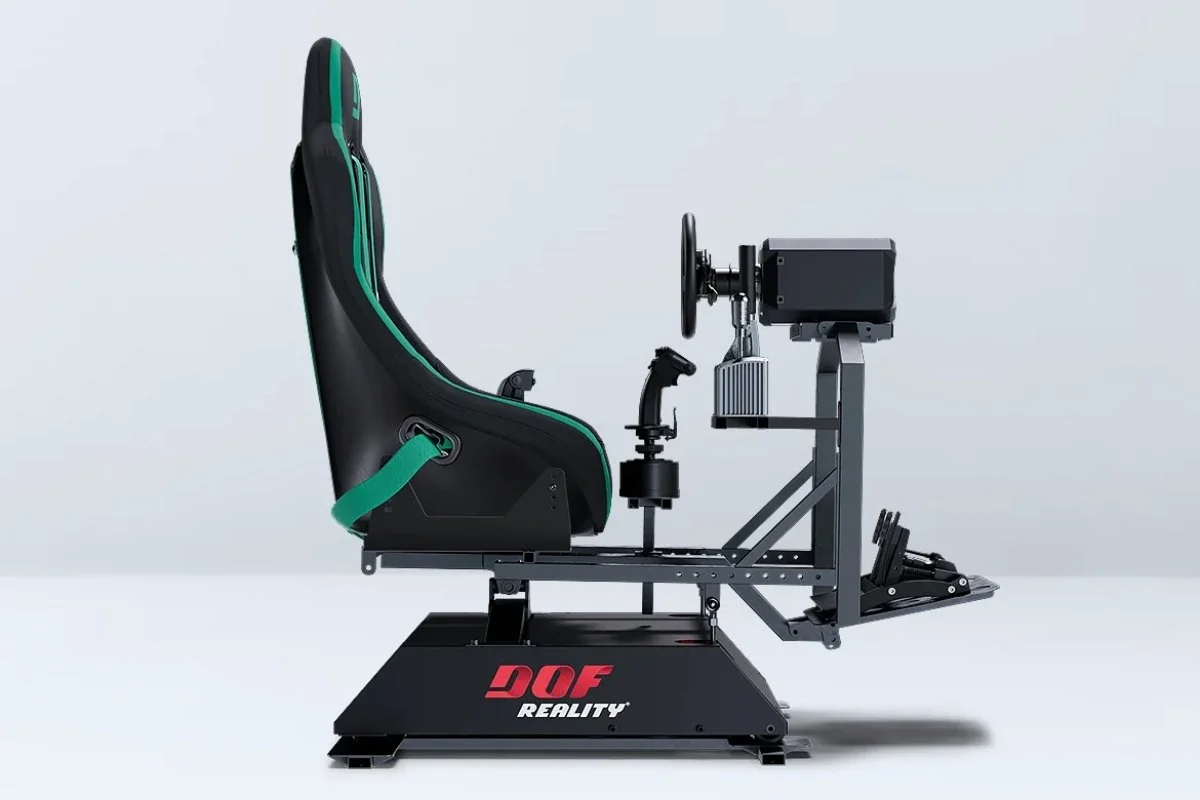
The DOF Reality H3 is the specific recommendation at the 3DOF level — it delivers all three axes at a price point that represents excellent value and it is well-supported by the sim racing community.
If 2DOF specifically suits your requirements, the eMotion Simulators e2 is the strongest option at its price point — a premium 2DOF experience with motion quality that stands out from most of its competition.
Both are available from SimTorque with free UK delivery.
View the DOF Reality H3 at SimTorque →
[ https://simtorque.co.uk/products/dof-reality-h3-3dof-motion-simulator-platform ]
View the eMotion Simulators e2 at SimTorque →
[ https://simtorque.co.uk/products/emotion-simulators-e2-pitch-roll-motion-platform ]
FAQ
Is the difference between 2DOF and 3DOF noticeable?
Yes, clearly and immediately. The traction loss axis communicates information that is physically distinct from pitch and roll. Most sim racers notice the difference within the first few laps on a 3DOF platform.
Can you upgrade from 2DOF to 3DOF?
Some manufacturers offer upgrade paths between DOF levels. DOF Reality sells upgrade kits for some configurations. However, upgrading is generally less straightforward and cost-effective than purchasing the correct DOF level initially.
Does 3DOF cause more motion sickness than 2DOF?
Motion sickness risk varies by individual. The yaw axis of a 3DOF platform can be disorienting for some users when not properly tuned. Starting with conservative motion settings and increasing gradually is recommended for any motion platform setup.
What games support traction loss feedback?
Any game with a detailed vehicle physics model generates traction loss data that SimTools can use. Assetto Corsa, ACC, iRacing, rFactor 2 and Dirt Rally 2.0 all produce excellent traction loss feedback. Arcade-style games produce less useful motion data.
Is 3DOF worth it for casual sim racers?
If you are sim racing regularly and care about car feel, yes. Even for casual sim racers, the traction loss axis adds an element of physical engagement that makes the experience more enjoyable. The question is whether the investment is proportionate to the rest of your setup.